
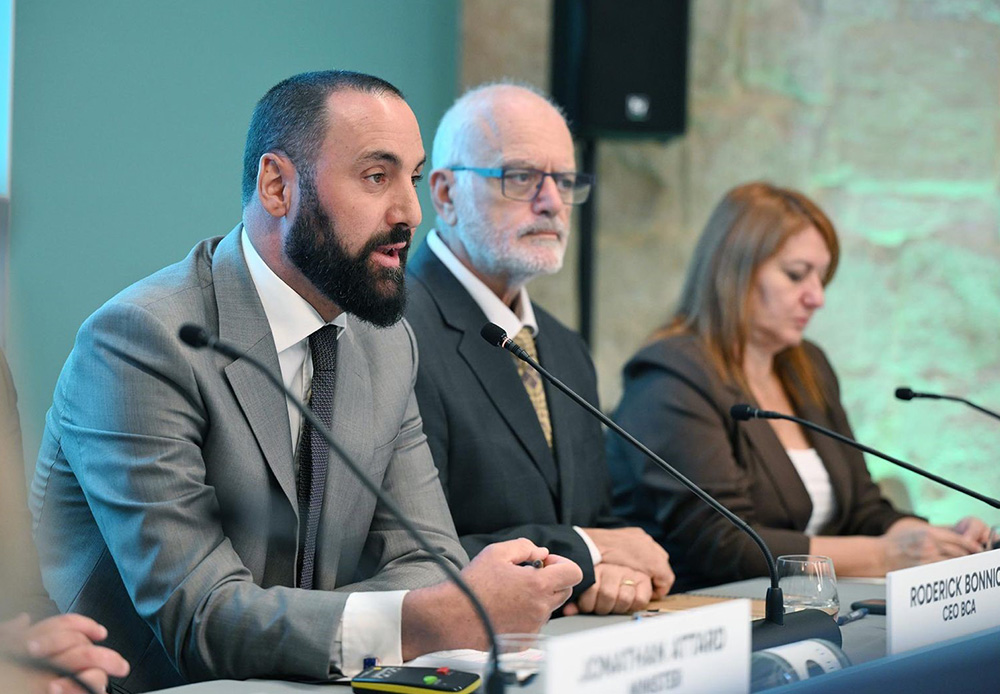
Minister for Justice and Reform in the Construction sector, Jonathan Attard, addressed the Envision 2050 conference: “Smart, Sustainable and Regulated Built Environment”, emphasising the importance of a stronger citizen voice and higher competences in the process of reform and consultation in the construction sector.
“Citizens should have a stronger voice in the consultative process in the sector,” said Minister Attard, while stressing the new dimension that the Building and Construction Consultative Council (BCCC) should take. The Minister said that we need to look at how this Council, which to date has been a forum of consultation between stakeholders, becomes a key instrument of public participation.
The Minister reminded those present that the construction industry was in a situation whereby it was established that there were 50 years of work to recover, and therefore the Government is working on a process of structured and sustainable reform.
“This is the beginning of a new culture, one that embraces competence, ethics and quality,” the Minister added, mentioning the main measures which have already come into effect, as well as those on which work is underway. These include the National Building and Construction Code, which will gradually be introduced over three years, the licensing of contractors, and the introduction of the Skill Cards by 2027. He also mentioned new services such as helpline 138, free lawyer and architect services, and joint inspections with OHSA.
Minister Attard also spoke about sustainability initiatives such as the BCA grant schemes, and the use of technology both in the sector and in the Authority’s work in its regulatory function.
He concluded by inviting all stakeholders and public entities to be an active part in this transformation process. “You present here represent our collective commitment to build a future where construction in Malta is truly smart, sustainable and driven by sound and responsible regulation.”
The Authority’s Chief Executive, Architect Roderick Bonnici who led this meeting, explained that in order to be in possession of a skill card one must have taken a course of health and safety awareness as well as verifying that one has a particular trade.
Among the topics discussed during this meeting were the Code and standards related to buildings, licensing, workers regulations, building quality and compliance, the management of construction sites, digital innovation in construction, schemes related to cleaner energy in buildings and building materials, among other topics related to buildings and construction.
On his part, the CEO of the Building and Construction Authority, Architect Roderick Bonnici, said that the Authority aims to promote sustainable practices when it comes to construction. He explained that this aim goes hand in hand with that stipulated in the 2050 vision document.
“As an Authority we are seeing that the sector evolves with today’s practices and technologies. To this end, the Authority is working and insisting strongly on the education of all parties involved in the sector, whether professionals, contractors, masons, or manual workers working in this sector. In the past year the Authority has started with a system that brings together all parties and discusses the evolution of the industry, so that we can take a more holistic approach to today’s and future challenges. The Authority is doing this while continuing to safeguard the public from the impact that the construction sector may have on the same public,” concluded Architect Bonnici.
Permanent Secretary Ronald Mizzi, responsible for the Co-ordination and Implementation of the Malta 2050 vision within the Office of the Prime Minister, praised the approach towards the discussion. He stressed that such discussions look at the future of our buildings, which materials we will use and in which areas, the skills and investments needed, sustainable energy, emissions and building codes. The event brought together a large number of stakeholders, constituted bodies, and partners, and this shows our country’s commitment to this discussion which leads us into this journey by 2050, based on the quality of life.
Representatives of the Occupational Health and Safety Authority, the Planning Authority, the Environment and Resources Authority, the Chamber of Architects, the Chamber of Engineers, the Chamber of Construction Management, the Civil Protection Department, the Malta Police force, the Association of Contractors in Demolition and Excavation, the Association of Builders and Contractors, the Malta Developers Association, the Property Market Agency, Enemalta, the Water Services Corporation, Transport Malta, LESA, the Department of Local Government, Infrastructure Malta, the Superintendence for Cultural Heritage, the Climate Action Authority, the University of Malta, MCAST, the Building and Construction Consultative Council, and the Regional Councils of Malta and Gozo, were present for this meeting.